TB-500 (Thymosin Beta-4)
Also known as Thymosin Beta-4
TB-500, the synthetic 43-amino-acid version of Thymosin Beta-4, accelerates tissue repair by upregulating actin polymerization, promoting cell migration, angiogenesis, and anti-inflammatory cytokine profiles—achieving 61% wound re-epithelialization by day 7 versus saline controls while preventing scar formation through collagen organization. It sequesters actin monomers to facilitate cytoskeletal remodeling essential for endothelial cell movement, fibroblast proliferation, and myocyte regeneration across skin, muscle, tendon, ligament, heart, and cornea.
Route
Subcutaneous injection
Dose range
500 mcg – 1 mg
Frequency
Once per day (subcutaneous)
Cycle length
8–12 weeks
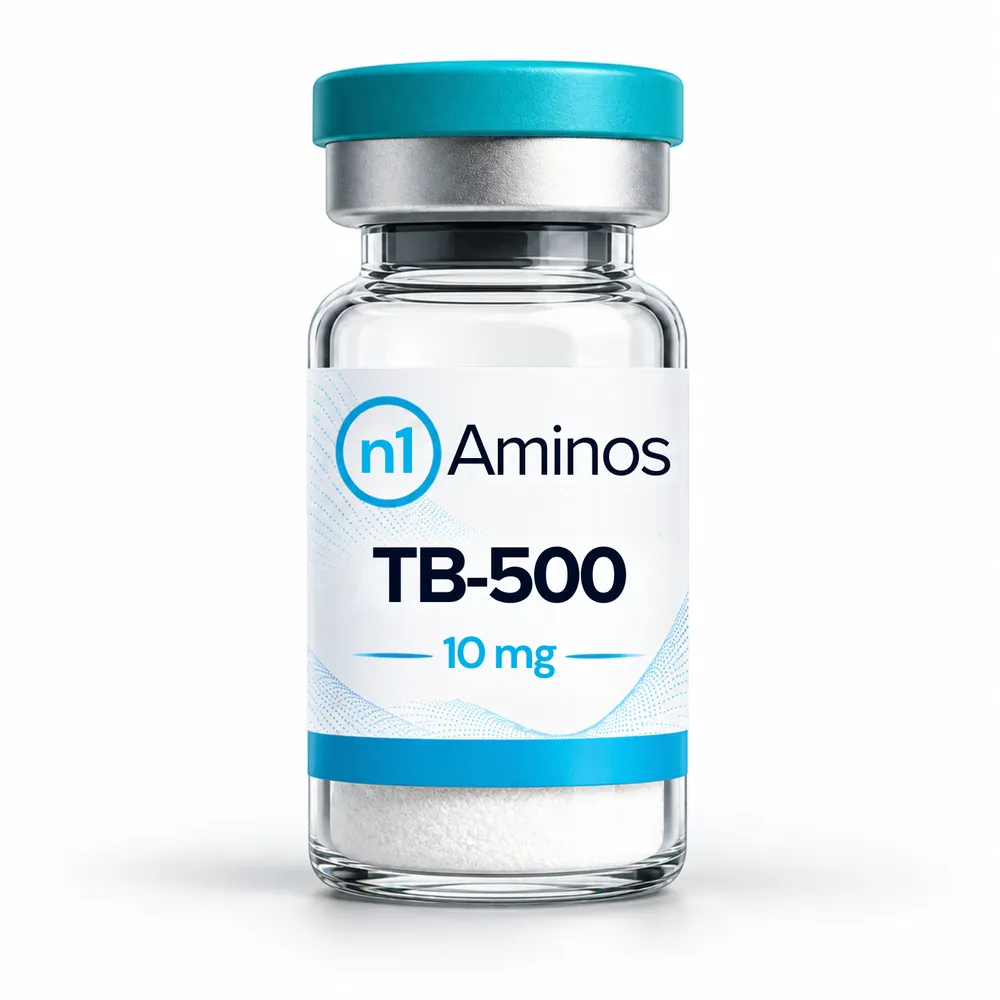
TB-500 10MG
Third-party tested, lot traceable, ships in 3–5 business days.
Overview
TB-500, the synthetic 43-amino-acid version of Thymosin Beta-4, accelerates tissue repair by upregulating actin polymerization, promoting cell migration, angiogenesis, and anti-inflammatory cytokine profiles—achieving 61% wound re-epithelialization by day 7 versus saline controls while preventing scar formation through collagen organization. It sequesters actin monomers to facilitate cytoskeletal remodeling essential for endothelial cell movement, fibroblast proliferation, and myocyte regeneration across skin, muscle, tendon, ligament, heart, and cornea.
Research demonstrates reduced inflammation via prostaglandin EP4 and nitric oxide suppression, enhanced cardiac repair post-infarction, and peripheral nerve regeneration. Dosed subcutaneously (2-10mg weekly), users report faster injury recovery, improved flexibility, reduced joint pain, and systemic healing without fibrosis. For athletes, chronic injuries, or surgical recovery, TB-500 represents comprehensive tissue remodeling superior to growth factors alone.
Studied benefits
- Promotes rapid wound healing, tissue repair, and the growth of new blood vessels (angiogenesis)
- It is widely used in research and veterinary settings to reduce inflammation and prevent excessive scar tissue (fibrosis) after injury
Reported side effects
- Generally well-tolerated
- human data is limited, but research settings report only occasional mild redness or tenderness at the injection site
Protocol
Dosing Schedule (Subcutaneous)
Educational reference only. Not medical advice. Research compounds are not approved for human use. Full disclaimer.
TB-500 (5mg)
Reconstitute with 3.0 mL bacteriostatic water (Final concentration: ~1.67 mg/mL).
Support tissue repair, wound healing, and angiogenesis through the active thymosin beta-4 fragment mechanism.
TB-500 (10mg)
Reconstitute with 3.0 mL bacteriostatic water (Final concentration: ~3.33 mg/mL).
Support tissue repair, wound healing, and angiogenesis through the active thymosin beta-4 fragment mechanism.
| Phase | Daily Dose (mcg) | Draw at 1.67 mg/mL | Log |
|---|---|---|---|
| Weeks 1–2 | 500 mcg | 30 units (0.3 mL) | + Log |
| Weeks 3–4 | 600 mcg | 36 units (0.36 mL) | + Log |
| Weeks 5–8 | 750 mcg | 45 units (0.45 mL) | + Log |
| Weeks 9–12 | 1000 mcg | 60 units (0.6 mL) | + Log |
Frequency
Once per day (subcutaneous).
Timing
Any consistent time daily; rotate injection sites.
Cycle length
8–12 weeks.
Unit calculator
Set your vial and water; the table above updates.
1.67 mg/mL
10 doses of 500 mcg per vial
At the starting dose (500 mcg × 7/week for a 8-week cycle) you would use about 28 mg, i.e. 6 × 5 mg vials. Higher phases use proportionally more.
Assumes a U-100 insulin syringe (100 units = 1 mL). Educational math only; verify every calculation yourself.
Context
Lifestyle considerations
Maintain a high-protein, balanced diet to provide the necessary substrate for the systemic tissue repair, wound healing, and angiogenesis promoted by this naturally occurring protein. Incorporate appropriate physical therapy or mobility-focused exercises to guide the remodeling of newly formed tissues and maintain joint flexibility during the recovery process. Ensure 7–9 hours of quality sleep to facilitate the deep-recovery phase where the peptide is most active at a cellular level. Practice stress management and maintain optimal hydration to reduce systemic oxidative stress, ensuring the healing environment is primed for cellular migration and regeneration.
Evidence
Research summaries
Thymosin Beta-4 Accelerates Wound Healing in Rat Full Thickness Wounds
Findings: Speeds up skin growth over wounds by 42-61%, boosts new blood vessel formation for better nutrient delivery, makes keratinocytes (skin cells) migrate to cover wounds faster.
TB-500, a fragment of thymosin beta-4, is nature's cell-movement maestro. In rats with big holes punched in their skin, topical or injected TB-500 closed wounds 42% faster by day 4, and up to 61% faster by day 7 compared to salt water. Why? It orchestrates keratinocyte (outer skin cell) migration—in tiny chambers, as little as 10 picograms (invisible amount!) sparked 2-3x more cell movement. Wounds also contracted (shrank) 11% more, a sign of healthy healing. Microscopy showed increased collagen and new blood vessels sprouting. Picture calling in construction workers with bulldozers—they arrive, move faster, and rebuild quicker. For burn victims, surgical wounds, or chronic non-healing ulcers (common in diabetics), TB-500 could cut healing time weeks shorter. Proof: reepithelialization measurements, contraction metrics, angiogenesis histology.
Read the study ↗Muscle Injury-Induced Thymosin β4 Acts as a Chemoattractant for Myoblasts During Skeletal Muscle Regeneration
Findings: Pulls muscle-building cells to injury sites, speeds muscle repair after tears or strain, rebuilds lost muscle faster without atrophy (shrinking).
Ripped muscles spill out thymosin beta-4—the body's emergency flare gun. TB-500 works as a chemical trail, luring myoblasts (baby muscle cells) to the damaged area like ants to honey. In lab dishes, TB-500 accelerated wound closure and pumped up myoblast movement toward the peptide. mRNA tests showed TB-4 expression spiked early in muscle regeneration—the body's own signal for repair. For athletes post-injury or teens with muscle strains from sports, TB-500 mimics this natural signal, pulling healing cells in fast. Microscopy and migration assays proved dose-dependent cell attraction.
Read the study ↗Thymosin Beta-4 Improves Endothelial Function and Reparative Capacity in Diabetic Ischemic Limb Disease
Findings: Grows new blood vessels in dead legs from diabetes, restores blood flow to prevent amputation, reduces cell death and aging in vessel linings.
Diabetic feet often can't heal—poor circulation kills tissue. TB-4 rescue team arrives: at 600 ng/mL, it supercharged endothelial cells (blood vessel linings) in diabetic models. Cell survival jumped (Bcl-XL up), aging markers dropped, and vessel-formation capacity (angiogenic potency) soared. In mice with bad circulation from diabetes, TB-4-treated endothelial cells grafted onto ischemic (starved) limbs improved blood vessel density and foot function—mice could walk better. The peptide cuts bad signals (endothelin-1, MMP-1 tissue destroyers) while cranking up pro-survival pathways (AKT). Under low-oxygen stress (simulating gangrene), TB-4 cells survived 3+ hours vs. controls dying fast. For teens at diabetes risk or with circulation problems, TB-500 could prevent amputations by regrowing circulation decades early. Proof: Western blots, flow cytometry, angiogenesis assays, in vivo perfusion studies.
Read the study ↗More references (4)
- Spatiotemporal Repair of Corneal Injury with TB500 Peptide Hydrogel, 2025
- Biological activities of thymosin $beta4$ defined by active sites in short peptide sequences, 2025
- Thymosin Beta-4: A Potential Therapeutic Target for Quiescent Hematopoietic Stem Cells, 2024
- Neuroprotective and neurorestorative effects of T$beta4$ following traumatic brain injury, 2013
Identification
Chemistry
- cas
- 885340-08-9 (TB-500 fragment free base); 77591-33-4 (full-length thymosin beta-4)
- formula
- C₃₈H₆₈N₁₀O₁₄ (TB-500 fragment); C₂₁₂H₃₅₀N₅₆O₇₈S (full thymosin beta-4)
- molecular weight
- 889.02 g/mol (TB-500 fragment); 4963.44 g/mol (full thymosin beta-4)
- sequence
- Ac-Leu-Lys-Lys-Thr-Glu-Thr-Gln (N-terminal acetyl group, eight amino acids: leucine, lysine, lysine, threonine, glutamic acid, threonine, glutamine)
- source
- Synthetic; derived from naturally occurring thymosin beta-4
- biosynthesis
- Non-ribosomal; chemically synthesized via solid-phase peptide synthesis (SPPS) with N-terminal acetylation
- type
- Linear octapeptide with N-terminal acetylation; free C-terminal carboxylic acid
Keep exploring
Related peptides
5-Amino-1MQ
5-amino-1-methylquinolinium · NNMTi
- Route
- Subcutaneous
- Dose
- 2.5 mg – 5 mg
- Cycle
- 10–20 days (based on a single 50 mg vial)
AHK-Cu
GHK-Cu · Copper Tripeptide-1
- Route
- Topical
- Dose
- —
- Cycle
- —
AICAR
Acadesine · AICA-Riboside
- Route
- Subcutaneous
- Dose
- 1 mg – 3 mg
- Cycle
- 8–12 weeks
ARA-290
ARA290 · Cibinetide
- Route
- Subcutaneous
- Dose
- 4 mg – 8 mg
- Cycle
- 4–8 weeks