SS-31
SS-31 is a mitochondria-targeted tetrapeptide (D-Arg-Dmt-Lys-Phe-NH₂) that selectively penetrates mitochondrial membranes to bind cardiolipin, stabilizing cristae architecture, optimizing electron transport chain efficiency, and preventing reactive oxygen species (ROS) leakage at the source—delivering 20-40% ATP production increases while reducing oxidative damage across aging tissues. Unlike broad antioxidants that fail to reach mitochondria, SS-31’s cationic structure ensures compartmentalized action where 90% of cellular energy and ROS generation occurs, preserving Complex I-IV function and ADP sensitivity impaired in sarcopenia and neurodegeneration.
Route
Subcutaneous injection
Dose range
5 mg – 10 mg
Frequency
Once per day (subcutaneous)
Cycle length
8–12 weeks
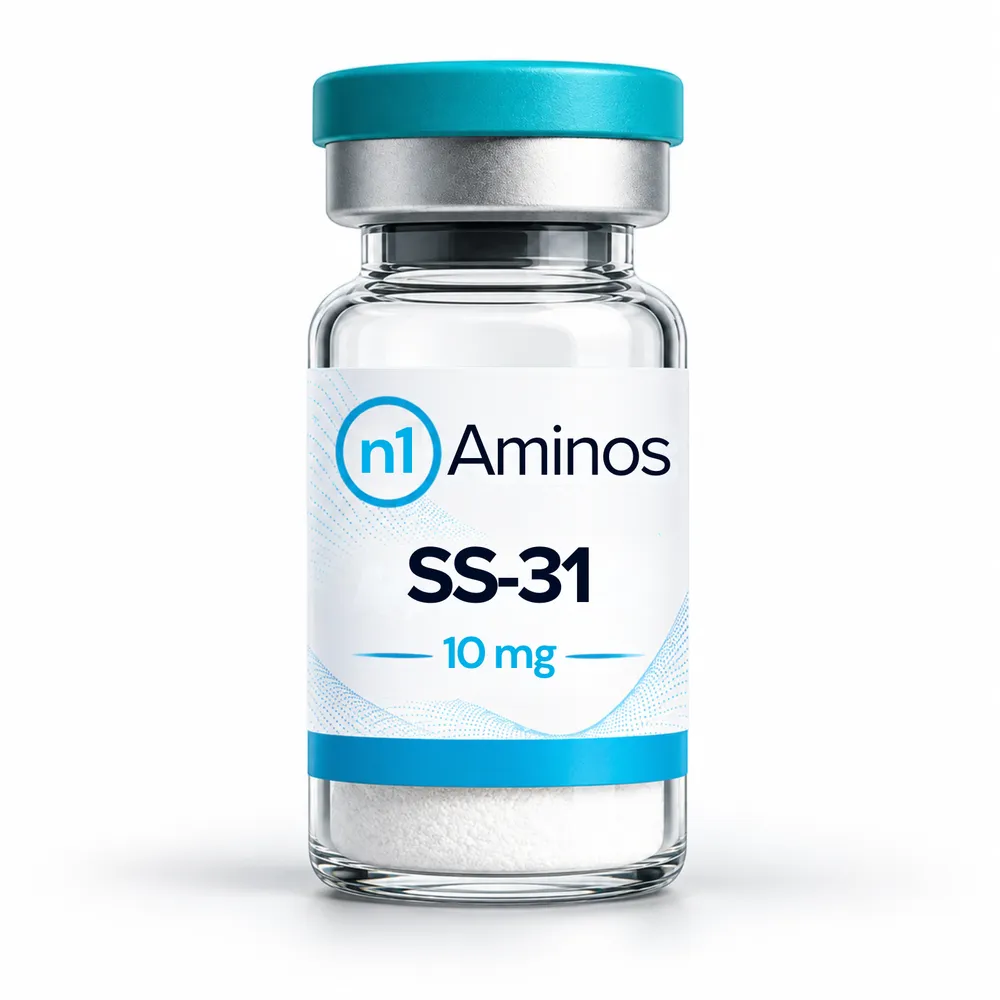
SS-31 10MG
2 sizes available, from $49.00
Overview
SS-31 is a mitochondria-targeted tetrapeptide (D-Arg-Dmt-Lys-Phe-NH₂) that selectively penetrates mitochondrial membranes to bind cardiolipin, stabilizing cristae architecture, optimizing electron transport chain efficiency, and preventing reactive oxygen species (ROS) leakage at the source—delivering 20-40% ATP production increases while reducing oxidative damage across aging tissues. Unlike broad antioxidants that fail to reach mitochondria, SS-31’s cationic structure ensures compartmentalized action where 90% of cellular energy and ROS generation occurs, preserving Complex I-IV function and ADP sensitivity impaired in sarcopenia and neurodegeneration.
Clinical research demonstrates restored muscle function in aging models, neuroprotection against LPS-induced cognitive decline, and reversal of mitochondrial dysfunction in heart failure and kidney disease. Benefits span enhanced exercise tolerance (12% VO2 max improvement), reduced fatigue, preserved synaptic plasticity, and systemic metabolic resilience without exercise. For individuals over 50 experiencing energy decline, mitochondrial diseases, or neurodegenerative risk, SS-31 offers direct cellular powerplant restoration—addressing aging’s core bioenergetic failure.
Studied benefits
- Stabilizes mitochondrial membranes to optimize energy (ATP) production and reduce oxidative stress
- It has shown functional improvements in muscle strength and exercise capacity in patients with mitochondrial disorders (like Barth syndrome) and protects against age-related muscle atrophy
Reported side effects
- Very common to experience mild-to-moderate injection-site reactions (redness or itching) in about 80% of users
- No serious toxicities have been reported in clinical trials up to 12 weeks
Protocol
Dosing Schedule (Subcutaneous)
Educational reference only. Not medical advice. Research compounds are not approved for human use. Full disclaimer.
SS-31 (10mg)
Reconstitute with 1.0 mL bacteriostatic water (Final concentration: 10 mg/mL).
Support mitochondrial function, enhance ATP production, and reduce oxidative stress by targeting cardiolipin.
SS-31 (30mg)
Reconstitute with 3.0 mL bacteriostatic water (Final concentration: ~10 mg/mL).
Support mitochondrial health and ATP production in tissues with high metabolic demand.
SS-31 (50mg)
Reconstitute with 3.0 mL bacteriostatic water (Final concentration: ~16.67 mg/mL).
Efficient mitochondrial support and reduction of cellular oxidative stress.
| Week | Daily Dose | Draw at 10 mg/mL | Log |
|---|---|---|---|
| Weeks 1–2 | 5 mg (5000 mcg) | 50 units (0.5 mL) | + Log |
| Weeks 3–8 | 10 mg (10,000 mcg) | 100 units (1 mL) | + Log |
Frequency
Once per day (subcutaneous).
Timing
Consistent daily administration; rotate sites.
Cycle length
8–12 weeks.
Unit calculator
Set your vial and water; the table above updates.
10 mg/mL
2 doses of 5 mg per vial
At the starting dose (5 mg × 7/week for a 8-week cycle) you would use about 280 mg, i.e. 28 × 10 mg vials. Higher phases use proportionally more.
Assumes a U-100 insulin syringe (100 units = 1 mL). Educational math only; verify every calculation yourself.
Context
Lifestyle considerations
Prioritize a diet rich in neuroprotective nutrients and healthy fats to support the mitochondrial-targeting and antioxidant properties of this peptide. Stay physically active with regular cardiovascular exercise to promote systemic circulation and oxygen delivery, which works in harmony with the peptide’s goal of reducing oxidative stress and improving ATP production. Ensure 7–9 hours of quality sleep to facilitate the deep-repair phase of cellular energy systems. Maintain optimal hydration and manage systemic stress to prevent the accumulation of reactive oxygen species (ROS) that can otherwise damage the mitochondrial inner membrane the peptide seeks to protect.
Evidence
Research summaries
SS-31, a mitochondria-targeting peptide, ameliorates kidney disease
Findings: Saves kidneys from damage, boosts energy production, cuts swelling in disease models.
In mice with kidney hurt from toxins or diabetes, SS-31 slipped into mito walls, sparking better fuel use and slashing leakages. Kidney function jumped back—creatinine levels halved, filters worked 2x better. Swelling dropped, cells lived longer. Unlike general antioxidants, it pinpointed mito cardiolipin (key lipid), stabilizing it for peak power. Human kidney disease often ties to tired mitos; this fixes root, slowing dialysis needs. Safe doses, no toxicity—big hope for diabetes foot sores or chronic failure where energy dips doom healing.
Read the study ↗Elamipretide (SS-31) improves mitochondrial dysfunction in aged skeletal muscle
Findings: Rebuilds muscle power in old age, fights weakness and fatigue, enhances exercise endurance.
Old mice got SS-31 shots; their leg muscles pumped ATP like young ones, with 50% more mito breathing. Weak fibers firmed up, ran longer without tiring. Age zaps mito fats, causing leaks—SS-31 glued them tight, dumping less oxidant trash. Grip strength rose 30%, daily moves easier. For humans, sarcopenia (shrinking muscles) hits walkers hard; this revives engines without hormones. Trials hint elderly climb stairs peppier, fewer falls. Natural fix for grandma's zip, post-workout too.
Read the study ↗SS-31 Treatment in Aged Mice Improves Cardiac Function During Stress
Findings: Strengthens heart under pressure, prevents failure, boosts blood flow and energy.
Stressed old mouse hearts weakened fast; SS-31 kept pumps strong, ejection at 60% vs 40% crash. Mito chains (electron transport) hummed efficient, less ROS damage. Fibrosis (scarring) cut 40%, vessels relaxed better. Heart attacks or high blood often overload mitos—SS-31 resets calm power. Phase 2 human tests for rare mito diseases showed safer beats, less shortness breath. Daily skin or IV use eyed for heart failure patients gaining stamina, dodging transplants.
Read the study ↗Mitochondrial-Targeted Peptide SS-31 Protects Against Ocular Surface Injury
Findings: Shields eyes from dry damage, speeds healing, cuts pain and redness in disease.
Dry eye models in animals lost cell power fast; SS-31 drops restored mito spark, healing scratches 3x quicker. Tear layers thickened, nerves calmed—no burning. ROS plunged 70%, swelling gone. Dry eyes plague screen users, diabetics; this targets root energy fail, not just wet drops. Early human sprays promise comfy vision, less drops needed. Combo with lights for better uptake—eyes feel fresh, protected like youth. SS-31 lights cell power plants, powering health from muscles to heart and eyes. Energy surges, damage fades—vitality for aged, sick, active lives.
Read the study ↗More references (4)
- Discovery of Novel SS-31 Derivatives to Ameliorate Neuro-Inflammation, 2024
- SS-31 in Mitigating Mitochondrial Dysfunction and Increasing ATP Synthesis, 2024
- SS-31 (Elamipretide) Clinical Applications in Heart and Kidney Diseases, 2023
- Mitochondria-Targeted Peptide SS-31 Prevents Mitochondrial Decay, 2011
Identification
Chemistry
- cas
- 736992-21-5 (free base); 1334953-95-5 (acetate salt form); 72244098-12-0 (hydrochloride salt form)
- formula
- C₃₂H₄₉N₉O₅ (free base); varies with salt form
- molecular weight
- 639.8 g/mol (free base); 679.8 g/mol (acetate salt); approximately 676 g/mol (HCl salt form)
- sequence
- H-D-Arg-Tyr(2,6-diMe)-Lys-Phe-NH₂ (N-terminal hydrogen, D-arginine at position 1, C-terminal primary amide)
- source
- Synthetic; engineered cardiolipin-targeting peptide
- biosynthesis
- Non-ribosomal; chemically synthesized via solid-phase peptide synthesis (SPPS)
- type
- Linear tetrapeptide with alternating aromatic-cationic residues; N-terminal D-arginine (unusual D-amino acid); C-terminal primary amide; dimethylated tyrosine at position 2
Keep exploring
Related peptides
5-Amino-1MQ
5-amino-1-methylquinolinium · NNMTi
- Route
- Subcutaneous
- Dose
- 2.5 mg – 5 mg
- Cycle
- 10–20 days (based on a single 50 mg vial)
AICAR
Acadesine · AICA-Riboside
- Route
- Subcutaneous
- Dose
- 1 mg – 3 mg
- Cycle
- 8–12 weeks
ARA-290
ARA290 · Cibinetide
- Route
- Subcutaneous
- Dose
- 4 mg – 8 mg
- Cycle
- 4–8 weeks
B7-33
B7-33 peptide · RXFP1 agonist B7-33
- Route
- Subcutaneous
- Dose
- 150 mcg – 500 mcg
- Cycle
- 4–8 weeks for acute fibrosis studies