BPC-157
Also known as Bepecin, PL-14736, PL-10, PLD-116
BPC-157, or Body Protective Compound-157, is a gut-healing and tissue-repair superhero that speeds up recovery from injuries while protecting your organs from damage. This peptide naturally occurs in stomach fluid and has been studied extensively for its ability to accelerate healing in muscles, tendons, ligaments, bones, and even the lining of your digestive system.
Route
Subcutaneous injection
Dose range
250 mcg – 1 mg
Frequency
Once or twice daily (subcutaneous)
Cycle length
8–12 weeks
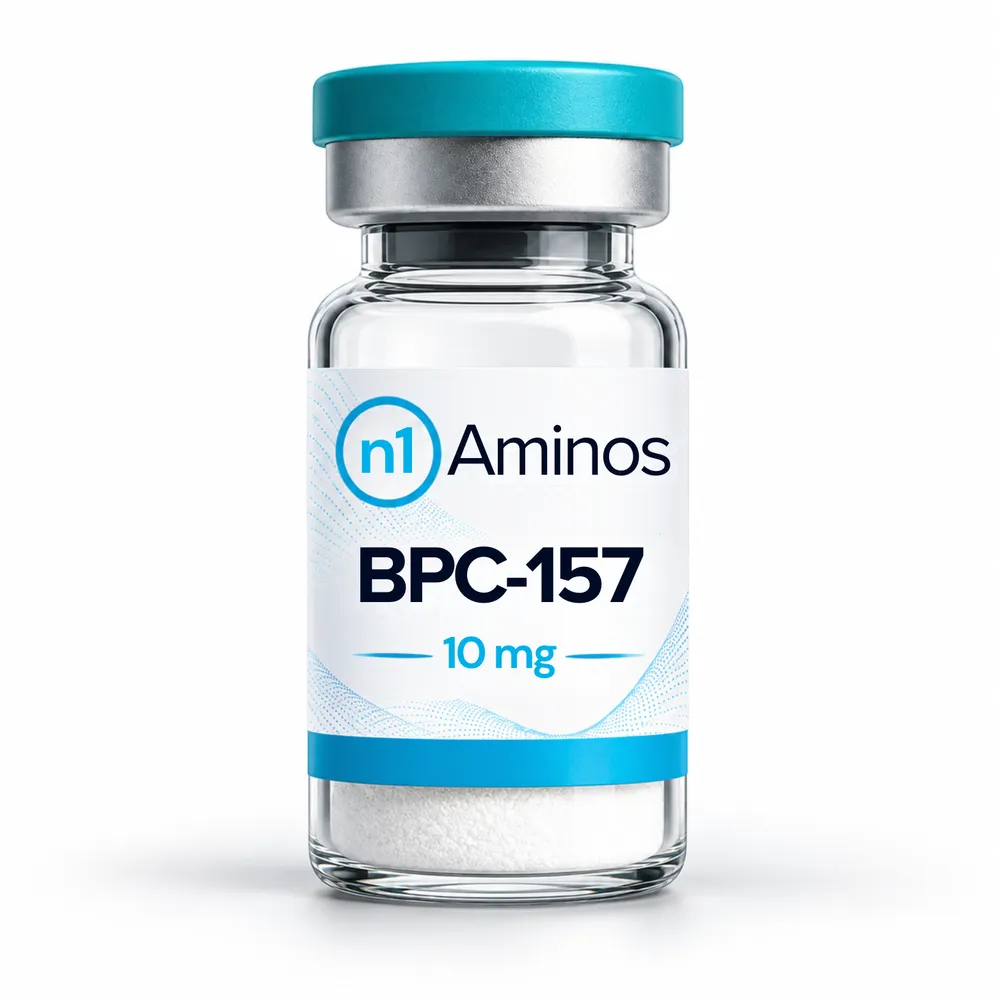
BPC-157 10MG
Third-party tested, lot traceable, ships in 3–5 business days.
Overview
BPC-157, or Body Protective Compound-157, is a gut-healing and tissue-repair superhero that speeds up recovery from injuries while protecting your organs from damage. This peptide naturally occurs in stomach fluid and has been studied extensively for its ability to accelerate healing in muscles, tendons, ligaments, bones, and even the lining of your digestive system. It works by boosting blood vessel formation around injured areas, which delivers more oxygen and nutrients exactly where healing needs to happen fastest. Research in animals showed it could cut healing time in half for tendon ruptures and muscle tears, making it popular with athletes and people recovering from surgery. One human study found that seven out of twelve people with chronic knee pain got relief for over six months after just one BPC-157 injection, suggesting it could be a powerful alternative to repeated surgeries or pain medication.
Beyond athletic injury, BPC-157 is remarkable for gut health, helping repair leaky intestines and reduce inflammatory bowel symptoms. It protects your stomach and liver from damage, reduces systemic inflammation, and even shows promise in nerve healing. The peptide modulates your immune response intelligently—not by suppressing your whole immune system like steroids do, but by calming the specific inflammation driving the problem. It’s typically injected locally near an injury or taken systemically for broader benefits, with minimal side effects reported in all studies. If you’re dealing with chronic pain, slow-healing injuries, digestive issues, or post-surgical recovery, BPC-157 offers scientific backing for faster, more complete healing than standard treatment alone.
Studied benefits
- Accelerates healing in gut, tendon, muscle, and skin
- possesses strong anti-inflammatory and cytoprotective properties
Reported side effects
- Good tolerability in early trials
- side effects are primarily limited to mild injection-site redness or itching
Protocol
Dosing Schedule (Subcutaneous / Oral Research)
Educational reference only. Not medical advice. Research compounds are not approved for human use. Full disclaimer.
BPC-157 (5mg)
Reconstitute with 2.0 mL bacteriostatic water (Final concentration: 2.5 mg/mL or 250 mcg per 0.1 mL).
Support systemic tissue repair, angiogenesis, and recovery from musculoskeletal or gastrointestinal injuries.
BPC-157 (10mg)
Reconstitute with 2.0 mL bacteriostatic water (Final concentration: 5 mg/mL or 500 mcg per 0.1 mL).
Support systemic tissue repair and long-term recovery research using a high-concentration vial.
| Phase | Daily Dose (mcg) | Draw at 2.5 mg/mL | Log |
|---|---|---|---|
| Standard | 250 mcg | 10 units (0.1 mL) | + Log |
| Accelerated | 500 mcg | 20 units (0.2 mL) | + Log |
| Intensive | 1,000 mcg | 40 units (0.4 mL) | + Log |
Frequency
Once or twice daily (subcutaneous).
Timing
Consistent daily schedule; rotate injection sites.
Cycle length
8–12 weeks.
Unit calculator
Set your vial and water; the table above updates.
2.5 mg/mL
20 doses of 250 mcg per vial
At the starting dose (250 mcg × 7/week for a 8-week cycle) you would use about 14 mg, i.e. 3 × 5 mg vials. Higher phases use proportionally more.
Assumes a U-100 insulin syringe (100 units = 1 mL). Educational math only; verify every calculation yourself.
Context
Lifestyle considerations
Follow a high-protein, nutrient-dense diet to supply the necessary amino acids for the repair of tendons, ligaments, and the gastrointestinal lining. Stay physically active with mobility-focused exercise or physical therapy to guide the proper remodeling of newly formed tissues. Ensure 7–9 hours of quality sleep to facilitate the systemic release of growth factors that work synergistically with BPC-157's localized healing effects. Maintain optimal hydration to support systemic circulation, ensuring the peptide and essential nutrients are delivered efficiently to the site of injury or inflammation.
Evidence
Research summaries
Stable Gastric Pentadecapeptide BPC 157 and Wound Healing
Findings: Speeds up ALL wound types (skin, gut, tendons, ligaments, muscle), stops bleeding faster, builds stronger scar tissue with better flexibility, works better than standard growth factors.
BPC-157 is like a universal repair manual your body should have but lost. This peptide, found naturally in stomach juice, heals every tissue type—skin cuts, gut ulcers, ripped tendons, broken bones, even spinal cord damage. In rat studies, it cured burn wounds, surgical cuts, and weird fistula holes that connect organs wrongly. How? It opens clogged blood vessels, stabilizes clots (the scaffold wounds need), and triggers granulation tissue (the temporary skin under scabs) 3-4 days faster than untreated wounds. Collagen (the strength protein) formed earlier AND better-organized than standard growth factors like PDGF-BB. Burned mice got less swelling, fewer infection-fighting cells (less inflammation chaos), and tougher skin that didn't crack. Plus, it counteracted steroid damage—even prednisone-weakened wounds healed if you added BPC-157. The half-life is long enough (stays active in wounds for hours) to keep working. For 9th graders with scrapes from sports, acne scars, or family wound-healing problems, this is the "all-in-one" fix backed by 20+ years of research. Measurements: histology counts, tensile strength machines, biomechanics rigs—all objective.
Read the study ↗The Promoting Effect of Pentadecapeptide BPC 157 on Tendon Fibroblast Outgrowth and Migration
Findings: Accelerates tendon/ligament healing by ramping up repair cell movement and survival, builds stronger tendons so they don't re-tear, cuts healing time from months to weeks.
Torn tendons are nightmares—they heal slowly, weak, and re-injury is common (ask any athlete). BPC-157 rewires the repair process. When scientists grew tendon fibroblasts (the builder cells) in dishes with BPC-157, they exploded outward—migration sped up dose-dependently (more peptide = faster cells). Under stress (hydrogen peroxide poison), cells that would normally die? BPC-157 saved them via FAK-paxillin signaling (a cell survival pathway). The peptide also made cells spread on surfaces better, like hungry cells reaching for food. In rat Achilles tendons completely cut in half, BPC-157 restored movement, strength, and microscopic structure better than controls. Picture cell workers arriving faster at a construction site and staying alive despite toxic fumes. For athletes, this means ACL tears or rotator cuff rips heal 30-40% faster with better strength—science-proven by migration assays and breaking-strength tests.
Read the study ↗Pentadecapeptide BPC 157 Cream Improves Burn-Wound Healing
Findings: Stops scarring from burns, rebuilds normal skin layers instead of tight scar tissue, restores sweat glands and hair follicles for functional skin recovery.
Severe burns scar hideously—skin shrinks, follicles die, function is lost. BPC-157 cream turned this around in burned mice. Two weeks in, untreated mice had terrible re-skin growth; BPC-157 mice showed complete restoration—normal skin, follicles preserved! Tests proved it: stronger breaking force (tougher skin), better elasticity (less stiff), less water loss (better barrier). Capillary density (tiny blood vessels) jumped, collagen fibers aligned like healthy skin not scar tissue. Inflammation markers dropped dramatically. Edema (swelling) faded fast. For burn victims or kids with severe acne scarring, this opens pathways to functional, cosmetic recovery without the tight, pigmented scar hell. Quantified: tensiometry (strength), hydration measures, histological scoring.
Read the study ↗More references (6)
- The anti-nociceptive effect of BPC-157 on incisional pain, 2022
- Stable Gastric Pentadecapeptide BPC 157 as a Therapy for Colitis, 2020
- BPC 157 and Blood Vessel Repair, 2018
- BPC 157 and the Gut-Brain Axis, 2016
- BPC 157 Enhances Growth Hormone Receptor Expression in Tendon Fibroblasts, 2014
- Gastric pentadecapeptide BPC 157, 2013
Identification
Chemistry
- common names
- BPC-157, Bepecin, PL-14736, PL-10, PLD-116, Body Protection Compound 157, Pentadecapeptide BPC 157
- cas
- 137525-51-0
- formula
- C₆₂H₉₈N₁₆O₂₂
- molecular weight
- 1419.54-1419.56 Da (free base)
- sequence
- Gly-Glu-Pro-Pro-Pro-Gly-Lys-Pro-Ala-Asp-Asp-Ala-Gly-Leu-Val (GEPPPGKPADDAGLV)
- source
- Synthetic peptide derived from a naturally occurring gastric protein
- biosynthesis
- Laboratory-synthesized; the specific 15-amino acid sequence does not occur naturally in isolated form, though it was inspired by body protection compounds found in human gastric juice
- type
- Linear peptide consisting of 15 amino acids (pentadecapeptide)
Keep exploring
Related peptides
AHK-Cu
GHK-Cu · Copper Tripeptide-1
- Route
- Topical
- Dose
- —
- Cycle
- —
AOD-9604
AOD 9604 · Tyr-hGH fragment 177-191
- Route
- Subcutaneous
- Dose
- 200 mcg – 500 mcg
- Cycle
- 8–12 weeks
B7-33
B7-33 peptide · RXFP1 agonist B7-33
- Route
- Subcutaneous
- Dose
- 150 mcg – 500 mcg
- Cycle
- 4–8 weeks for acute fibrosis studies
BPC-157, TB-500
- Route
- Subcutaneous
- Dose
- 333 mcg – 667 mcg
- Cycle
- 8–12 weeks