AOD-9604
Also known as AOD 9604, Tyr-hGH fragment 177-191, Tyr-somatostatin 177-191, HGH fragment 176-191
AOD-9604 is a fat-burning peptide that tricks your body into breaking down stored fat more efficiently, kind of like giving your metabolism a boost. It’s derived from human growth hormone but was specifically designed to avoid the side effects that regular growth hormone can cause.
Route
Subcutaneous injection
Dose range
200 mcg – 500 mcg
Frequency
Once per day (subcutaneous)
Cycle length
8–12 weeks
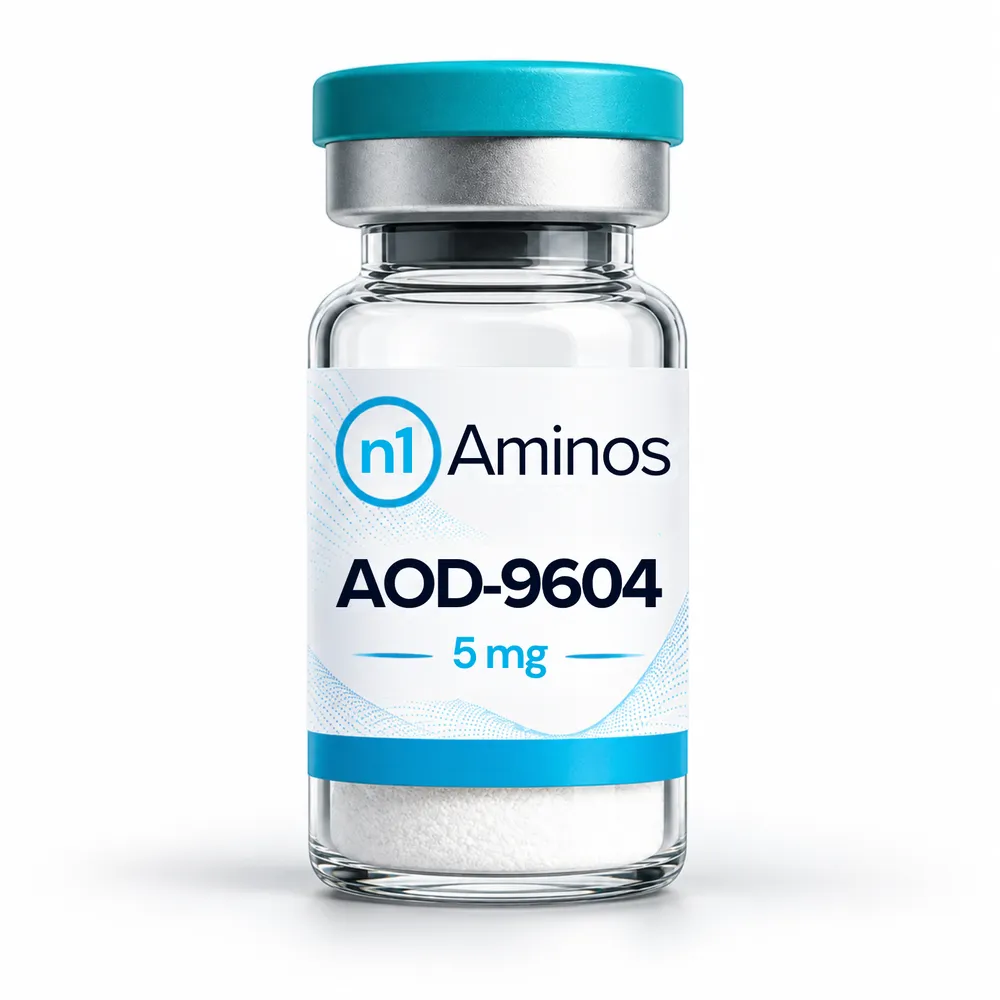
AOD-9604 5MG
Third-party tested, lot traceable, ships in 3–5 business days.
Overview
AOD-9604 is a fat-burning peptide that tricks your body into breaking down stored fat more efficiently, kind of like giving your metabolism a boost. It’s derived from human growth hormone but was specifically designed to avoid the side effects that regular growth hormone can cause. The magic is that AOD-9604 signals your body to break down existing fat stores for energy while also blocking your body from making new fat deposits—a double win for weight loss. It’s especially effective at targeting stubborn belly fat, the kind that’s hard to lose with just diet and exercise alone. Research shows people using AOD-9604 lost about 2-3 kg more than those on placebo over several months, without the blood sugar problems or muscle-loss concerns that come with regular growth hormone therapy.
Beyond weight loss, AOD-9604 offers bonus perks for joint and bone health, making it appealing if you’re dealing with arthritis or bone weakness. Studies suggest it can boost collagen and cartilage production, helping repair damaged joints and potentially slowing degenerative conditions. The peptide works through injections, usually five times per week, with most people seeing noticeable results after two to three months of consistent use. What sets it apart is its safety profile—it doesn’t spike hunger hormones like some weight-loss drugs, and it doesn’t mess with your natural growth hormone levels. If you’ve hit a weight-loss plateau or struggle with stubborn fat despite healthy eating and exercise, AOD-9604 could be a game-changer for reshaping your body composition.
Studied benefits
- Promotes abdominal fat loss and oxidation without disrupting IGF-1 levels
- potential for cartilage and bone repair
Reported side effects
- Exhibits a safety profile similar to placebo
- may cause minor injection-site reactions
Protocol
Dosing Schedule (Subcutaneous)
Educational reference only. Not medical advice. Research compounds are not approved for human use. Full disclaimer.
AOD-9604 (2mg)
Reconstitute with 3.0 mL bacteriostatic water (Final concentration: ~0.667 mg/mL).
Support reduction of fat mass and enhance fat oxidation over time.
AOD-9604 (5mg)
Reconstitute with 3.0 mL bacteriostatic water (Final concentration: ~1.67 mg/mL).
Support reduction of fat mass and enhance fat oxidation over time using a higher-capacity vial.
| Phase | Daily Dose (mcg) | Draw at 0.67 mg/mL | Log |
|---|---|---|---|
| Weeks 1–2 | 200 mcg | 30 units (0.3 mL) | + Log |
| Weeks 3–4 | 300 mcg | 45 units (0.45 mL) | + Log |
| Weeks 5–12 | 500 mcg | 75 units (0.75 mL) | + Log |
Frequency
Once per day (subcutaneous).
Timing
Morning administration (fasted) is common; rotate injection sites.
Cycle length
8–12 weeks.
Unit calculator
Set your vial and water; the table above updates.
0.67 mg/mL
10 doses of 200 mcg per vial
At the starting dose (200 mcg × 7/week for a 8-week cycle) you would use about 11.2 mg, i.e. 6 × 2 mg vials. Higher phases use proportionally more.
Assumes a U-100 insulin syringe (100 units = 1 mL). Educational math only; verify every calculation yourself.
Context
Lifestyle considerations
Follow a calorie-controlled, high-protein diet to maximize the peptide’s lipolytic (fat-burning) effects without interfering with natural growth hormone levels. Incorporate both resistance training and aerobic exercise to utilize the increased availability of circulating fatty acids for energy production. Ensure 7–9 hours of quality sleep to support metabolic homeostasis and hormonal regulation. Practice consistent dosing, ideally on an empty stomach (30–60 minutes before food), to ensure the peptide can act efficiently on adipose tissue receptors without interference from post-prandial insulin spikes.
Evidence
Research summaries
Metabolic Studies of a Synthetic Lipolytic Domain (AOD9604) of Human Growth Hormone in Obese Zucker Rats
Findings: Burns belly fat without messing with insulin like full growth hormone does, shrinks fat cells through activation of fat-burning engines, safe for people worried about diabetes or hormonal side effects.
Growth hormone (GH) is powerful but risky—too much messes up insulin and grows everything wild. Scientists snipped just the fat-burning part (amino acids 177-191), called AOD-9604. In obese Zucker rats, AOD-9604 shrunk body weight gain by 25% compared to controls after chronic treatment. Fat tissue showed way more lipolysis (fat cell death) and glycerol leakage—proof cells were melting fat fast. Here's the kicker: unlike real GH, AOD-9604 didn't wreck insulin sensitivity. Euglycemic clamp tests (gold standard for insulin check) proved it safe. Rats stayed metabolically healthy, blood sugar steady. For a 9th grader on the chubby side or with diabetes in the family, it's diet-pill hope: drop pounds without hormone chaos. Measurements were exact—direct fat tissue sampling post-necropsy, lipolysis assays rock-solid. This opened doors to oral pills, big news for an industry stuck with shots.
Read the study ↗Increase of Fat Oxidation and Weight Loss in Obese Mice Caused by AOD-9604
Findings: Torch fat 24/7 even at rest, boost energy use throughout day, trim pounds without losing muscle like starvation diets do.
Imagine a tiny spark plug in every fat cell, firing constantly to burn fuel. AOD-9604 lights that spark by ramping up beta-3 adrenergic receptors (the main lipolysis switches in fat). In ob/ob mice, both hGH and AOD-9604 cut weight gain, but only AOD was safe. In vivo fat oxidation jumped, plasma glycerol levels (fat breakdown marker) spiked 40%+. Energy balance shifted: more calories out, fat melted. Obese mice started with squashed beta-3-AR expression (a reason they're fat—broken brakes). AOD-9604 restored levels to near-lean mice, reawakening the furnace. Knockout mice lacking this receptor? AOD failed—proves it's the target. Wild: in acute tests, AOD still boosted energy expenditure even without the receptor, hinting other paths too. No hyperglycemia, no insulin crash like GH. For kids, it's metabolic rewiring: teach fat cells to burn again. Results quantified: gravimetric methods, blood assays, gene expression PCR.
Read the study ↗The Effects of Human GH and Its Lipolytic Fragment (AOD9604) on Beta-3-Adrenergic Receptor Expression in Obese Mice
Findings: Fixes broken fat-cell signals in obesity, restores natural fat-burning power lost from junk food, sustainable metabolism without drugs wearing off.
Obesity isn't just eating too much—fat cells become dumb, ignoring "burn" signals. AOD-9604 rehabs them. After 14 days of chronic injections in obese mice, beta-3-AR RNA (the receiver antenna for fat burn) climbed from broken levels back to lean-mouse levels. Weight dropped, body fat shrank. Both hGH and AOD-9604 worked, but AOD was the cleaner path—no side risks. When scientists deleted the beta-3 gene entirely, AOD failed in chronic tests—slam dunk proof it's the mechanism. Acutely though? AOD still worked, suggesting backup burnouts exist. Picture rewiring a dead battery charger: first, the main cable (beta-3) lights up. For chunky teens stuck in slow-metabolism hell, this restores their cellular thermostat. Proof: Northern blot analysis, densitometry, DEXA for body composition. Long-term, could beat dieting by fixing what's actually broken.
Read the study ↗More references (6)
- Effect of AOD9604 on bone and cartilage repair, 2015
- Safety and tolerability of AOD9604 in humans, 2013
- Comparison of hGH and AOD9604 on lipid metabolism, 2006
- Mechanism of action of the hGH fragment AOD9604, 2004
- Increase of fat oxidation and weight loss in obese mice by AOD9604, 2001
- Metabolic studies of a synthetic lipolytic domain of hGH, 2001
Identification
Chemistry
- common names
- AOD-9604, AOD 9604, Tyr-hGH fragment 177-191, Tyr-somatostatin 177-191, HGH fragment 176-191, Fragment 177-191
- cas
- -
- formula
- C₇₈H₁₂₃N₂₃O₂₃S₂
- molecular weight
- 1815.1 g/mol (1815.08-1815.10 range)
- sequence
- -
- source
- Synthetic peptide fragment rationally derived from human growth hormone C-terminal sequence; not naturally occurring as isolated peptide
- biosynthesis
- Produced via solid-phase peptide synthesis (SPPS); contains amino acids 177-191 of natural hGH with N-terminal tyrosine substitution replacing natural phenylalanine
Keep exploring
Related peptides
5-Amino-1MQ
5-amino-1-methylquinolinium · NNMTi
- Route
- Subcutaneous
- Dose
- 2.5 mg – 5 mg
- Cycle
- 10–20 days (based on a single 50 mg vial)
Adipotide (FTPP)
FTPP · Adipotide
- Route
- Subcutaneous
- Dose
- 5 mcg – 20 mcg
- Cycle
- 21–28 days; monitoring of renal markers is standard
AICAR
Acadesine · AICA-Riboside
- Route
- Subcutaneous
- Dose
- 1 mg – 3 mg
- Cycle
- 8–12 weeks
BPC-157
Bepecin · PL-14736
- Route
- Subcutaneous
- Dose
- 250 mcg – 1 mg
- Cycle
- 8–12 weeks