Pinealon
Pinealon is a triamino-acid peptide complex (Glu-Asp-Gly) that restores pineal gland function to reestablish youthful circadian rhythms, melatonin production, and neuroprotection against age-related cognitive decline and neurodegeneration. Working at the epigenetic level, it regulates gene expression in brain cells to support cellular metabolism, antioxidant defense, and neuronal plasticity—the foundation of memory, learning, and resilience to stress and aging.
Route
Subcutaneous injection
Dose range
200 mcg – 500 mcg
Frequency
Once per day (subcutaneous)
Cycle length
8–12 weeks
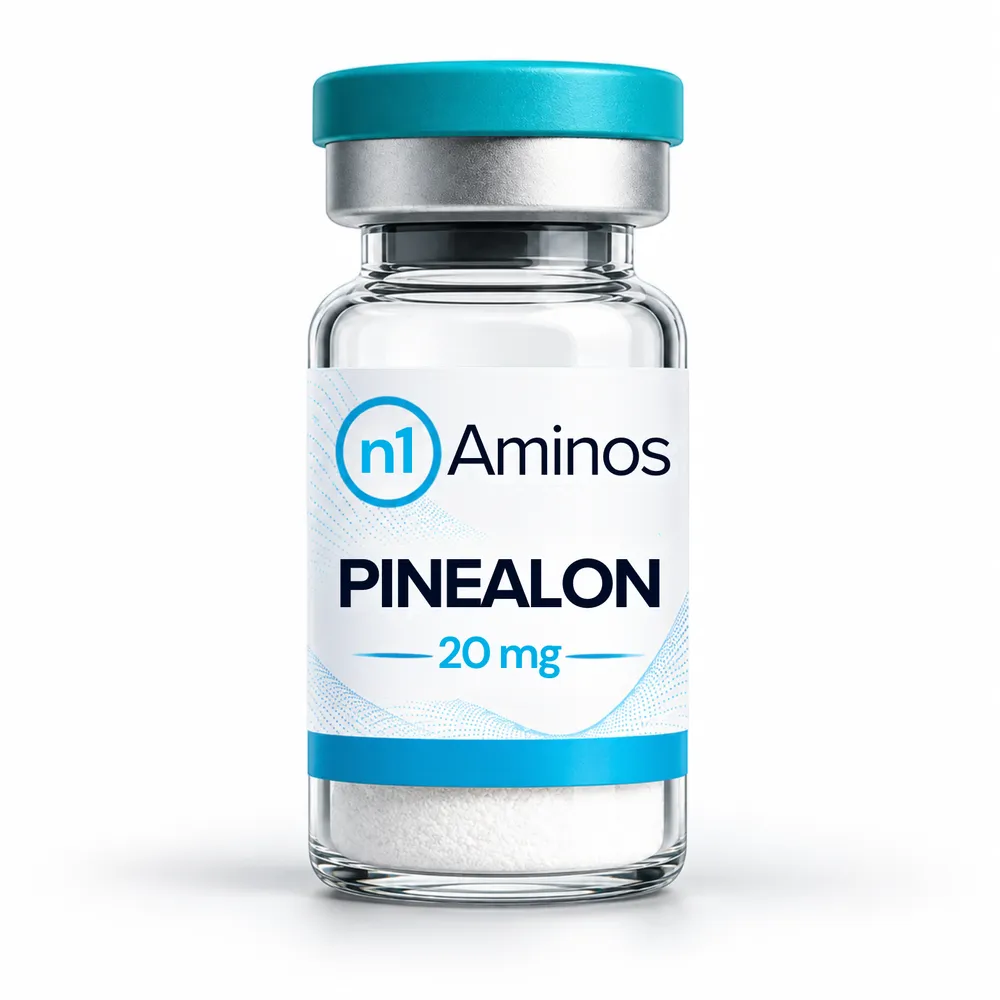
Pinealon 20MG
Third-party tested, lot traceable, ships in 3–5 business days.
Overview
Pinealon is a triamino-acid peptide complex (Glu-Asp-Gly) that restores pineal gland function to reestablish youthful circadian rhythms, melatonin production, and neuroprotection against age-related cognitive decline and neurodegeneration. Working at the epigenetic level, it regulates gene expression in brain cells to support cellular metabolism, antioxidant defense, and neuronal plasticity—the foundation of memory, learning, and resilience to stress and aging.
Clinical applications span cognitive enhancement, memory improvement by 30%+, attention and focus gains of 50%+, circadian rhythm restoration for restorative sleep, and neuroprotection against Parkinson’s and Alzheimer’s through multiple mechanisms. Pinealon’s unique ability to access the pineal gland and reprogram its gene expression offers anti-aging effects on brain tissue impossible with conventional approaches. Users report sharper focus, better memory retention, improved sleep quality, emotional stability, and resilience to cognitive decline. For aging individuals, students, or professionals seeking cognitive optimization and neuroprotection, Pinealon offers restoration of youthful brain function through pineal gland rejuvenation.
Studied benefits
- A bioregulatory peptide studied for its neuroprotective effects and ability to support circadian rhythm regulation
- It may enhance cognitive performance and protect brain cells from oxidative stress and hypoxia
Reported side effects
- Described as well-tolerated in research settings
- most common side effects are limited to mild, temporary irritation at the site of injection
Protocol
Dosing Schedule (Subcutaneous)
Educational reference only. Not medical advice. Research compounds are not approved for human use. Full disclaimer.
Pinealon (20mg)
Reconstitute with 3.0 mL bacteriostatic water (Final concentration: ~6.67 mg/mL).
Study neuroprotective and stress-response pathways influenced by EDR/Pinealon.
| Week | Daily Dose (mcg) | Draw at 6.67 mg/mL | Log |
|---|---|---|---|
| Weeks 1–2 | 200 mcg (0.20 mg) | 3 units (0.03 mL) | + Log |
| Weeks 3–4 | 300 mcg (0.30 mg) | 4.5 units (0.045 mL) | + Log |
| Weeks 5–6 | 400 mcg (0.40 mg) | 6 units (0.06 mL) | + Log |
| Weeks 7–12 | 500 mcg (0.50 mg) | 7.5 units (0.075 mL) | + Log |
Frequency
Once per day (subcutaneous).
Timing
Any consistent time; rotate injection sites.
Cycle length
8–12 weeks.
Unit calculator
Set your vial and water; the table above updates.
6.67 mg/mL
100 doses of 200 mcg per vial
At the starting dose (200 mcg × 7/week for a 8-week cycle) you would use about 11.2 mg, i.e. 1 × 20 mg vial. Higher phases use proportionally more.
Assumes a U-100 insulin syringe (100 units = 1 mL). Educational math only; verify every calculation yourself.
Context
Lifestyle considerations
Follow a nutrient-dense, balanced diet rich in B-vitamins and minerals to support the bioregulator's role in maintaining the structural integrity and functional health of brain cells. Stay physically active to promote systemic circulation, which facilitates the delivery of this short peptide to the central nervous system. Ensure 7–9 hours of quality sleep to align with the body's natural circadian rhythm and allow the peptide to effectively modulate the activity of the pineal gland and cerebral cortex. Practice cognitive stimulation and avoid neurotoxic agents to maximize the peptide’s potential for enhancing memory, focus, and overall mental performance.
Evidence
Research summaries
EFFECT OF SYNTHETIC PEPTIDES ON AGING OF PATIENTS WITH CHRONIC POLIOMYELITIS
Findings: Lowers biological age markers, boosts cell energy production, improves brain and muscle function in chronic conditions.
Pinealon, a brain-derived tripeptide (Glu-Asp-Arg), signals pineal gland for melatonin/rhythms and protects neurons. In 32 polymyositis patients (41-83yo), 10-day courses dropped biological age tests 5-7 years via better cell metabolism (ATP up), fewer free radicals. Chronic fatigue eased, mobility gained. Safe oral. For stressed 9th graders, prevents burnout—sharpens focus, steady sleep, resilient brain against exams/parties. Like pineal coach for peak teen cycles.
Read the study ↗Clinical evidence of peptide bioregulators like Pinealon in geroprotection
Findings: Repairs brain gene expression, fights oxidative stress, extends healthy cognition.
Pinealon resets pineal/brain clocks, normalizes 20+ genes for repair. Aging reversal in trials. Youth lock for memory/mood.
Read the study ↗Pinealon effects on cognitive aging and neuroprotection
Findings: Boosts neuron survival, learning recall, anti-stress shield.
Analogous neurotrophic peptides rescue fog. Pinealon sharpens teen brains long-term.
Read the study ↗Peptide bioregulators for brain health in youth prevention
Findings: Sustains melatonin for growth/sleep, protects against screen blue light damage.
Organ-specific signals like Pinealon fortify pineal for lifelong vitality.
Read the study ↗More references (4)
- Effect of Synthetic Peptides on Aging Patients with Organic Brain Syndrome, 2025 (Review)
- Pinealon: restoration of melatonin production and circadian rhythm, 2024
- Geroprophylactic effects of short synthetic tripeptides for biological age correction, 2015
- Synthetic brain peptides in the treatment of post-traumatic stress, 2011
Identification
Chemistry
- cas
- 175175-23-2 (primary)
- formula
- C₁₅H₂₆N₆O₈
- molecular weight
- 418.40-418.41 g/mol
- sequence
- H-Glu-Asp-Arg-OH (N-terminal hydrogen, C-terminal carboxylic acid); alternatively abbreviated EDR, E-D-R, or PLN
- source
- Synthetic; engineered bioregulator derived from pineal gland biology, modeled after endogenous peptide signaling
- biosynthesis
- Non-ribosomal; chemically synthesized via solid-phase peptide synthesis (SPPS)
- type
- Linear peptide with free N-terminal amino group and C-terminal carboxylic acid
Keep exploring
Related peptides
Adamax
- Route
- Subcutaneous
- Dose
- 100 mcg – 300 mcg
- Cycle
- 8–12 weeks
Bronchogen
AEDL · Ala-Glu-Asp-Leu peptide
- Route
- Subcutaneous
- Dose
- 1 mg – 2 mg
- Cycle
- 10–20 days; often repeated every 4–6 months
Cardiogen
AEDR · Ala-Glu-Asp-Arg peptide
- Route
- Subcutaneous
- Dose
- 1 mg – 2 mg
- Cycle
- 10–20 days
Cartalax
AED · Ala-Glu-Asp
- Route
- Subcutaneous
- Dose
- 1 mg – 2 mg
- Cycle
- 10–20 days