GHK-Cu (Copper Peptide)
Also known as Copper Peptide
GHK-Cu is a regenerative powerhouse peptide that rebuilds collagen, accelerates wound healing, and triggers anti-aging effects by remodeling skin at the genetic level. The copper component acts as a critical cofactor for enzymes responsible for collagen cross-linking—making collagen strong and flexible—while GHK itself signals cells to produce new collagen, elastin, and other structural proteins.
Route
Subcutaneous injection
Dose range
1 mg – 2 mg
Frequency
Once per day (subcutaneous), 5 days per week
Cycle length
8–12 weeks
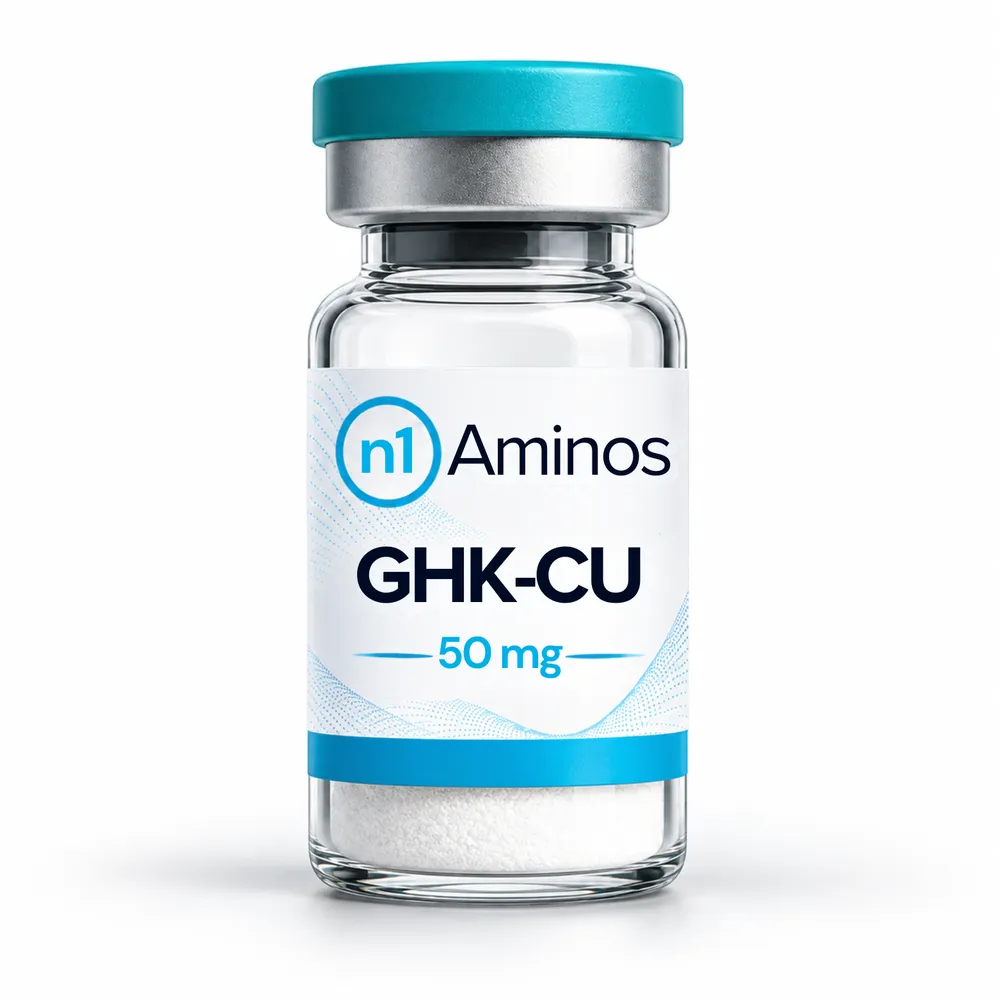
GHK-Cu 50mg
2 sizes available, from $29.00
Overview
GHK-Cu is a regenerative powerhouse peptide that rebuilds collagen, accelerates wound healing, and triggers anti-aging effects by remodeling skin at the genetic level. The copper component acts as a critical cofactor for enzymes responsible for collagen cross-linking—making collagen strong and flexible—while GHK itself signals cells to produce new collagen, elastin, and other structural proteins. Research shows it can close wounds 40-50% faster than standard treatments, reverse age-related collagen loss, even repair diabetic ulcers that resist healing, making it clinically transformative for skin and tissue regeneration.
Beyond visible skin improvements—fewer wrinkles, firmer texture, even tone—GHK-Cu supports hair growth by boosting follicle blood flow and reducing scalp inflammation, protects organs from oxidative damage through antioxidant mechanisms, and activates genes associated with youthfulness. The peptide literally resets aging gene expression patterns in cells, reversing cellular dysfunction associated with time. Used topically in serums or injected for systemic effects, it boosts tissue repair, supports immune function, and helps conditions driven by inflammation like COPD or arthritis by activating protective pathways. For anyone serious about skin rejuvenation, anti-aging, hair restoration, or accelerated healing from surgery or trauma, GHK-Cu offers evidence-based cellular regeneration that standard skincare cannot match.
Studied benefits
- Highly effective for skin rejuvenation and wound healing
- increases collagen density and reduces wrinkles
- It also supports hair growth, provides anti-inflammatory protection, and may assist in nervous system function
Reported side effects
- Excellent safety profile with a wide margin of tolerability
- potential for mild, transient redness or stinging at the injection site
Protocol
Dosing Schedule (Subcutaneous)
Educational reference only. Not medical advice. Research compounds are not approved for human use. Full disclaimer.
GHK-Cu (50mg)
Reconstitute with 3.0 mL bacteriostatic water (Final concentration: 16.67 mg/mL).
Support tissue remodeling, wound healing, and skin regeneration through documented biological pathways.
GHK-Cu (100 mg)
Reconstitute with 3.0 mL bacteriostatic water (Final concentration: ~33.3 mg/mL).
Support skin rejuvenation, collagen synthesis, wound healing, and anti-aging tissue repair.
| Week | Daily Dose (mg) | Draw at 16.67 mg/mL | Log |
|---|---|---|---|
| Weeks 1–4 | 1.0 mg | 6 units (0.06 mL) | + Log |
| Weeks 5–8 | 1.5 mg | 9 units (0.09 mL) | + Log |
| Weeks 9–12 | 2.0 mg | 12 units (0.12 mL) | + Log |
Frequency
Once per day (subcutaneous), 5 days per week.
Timing
Any consistent time; rotate injection sites.
Cycle length
8–12 weeks.
Unit calculator
Set your vial and water; the table above updates.
16.67 mg/mL
50 doses of 1 mg per vial
At the starting dose (1 mg × 1/week for a 8-week cycle) you would use about 8 mg, i.e. 1 × 50 mg vial. Higher phases use proportionally more.
Assumes a U-100 insulin syringe (100 units = 1 mL). Educational math only; verify every calculation yourself.
Context
Lifestyle considerations
Maintain a diet rich in antioxidants and essential minerals to support the systemic regenerative signaling and collagen remodeling promoted by the copper-binding peptide. Ensure 7–9 hours of nightly sleep to allow for the peak restorative cycles of the skin and connective tissues. Maintain a consistent skincare or hair-care regimen that includes broad-spectrum SPF to protect treated areas from environmental damage that could undermine the peptide’s effects. Stay hydrated and avoid smoking, which introduces free radicals that degrade the extracellular matrix GHK-Cu seeks to repair.
Evidence
Research summaries
GHK Peptide as a Natural Modulator of Multiple Cellular Pathways in Skin Regeneration
Findings: Speeds wound healing, ramps collagen/elastin for firm skin, fights aging lines and scars.
GHK-Cu, a copper-bound trio peptide in young blood, drops with age. It flips 4,000+ genes for repair: up bFGF/VEGF for vessels, collagen for bounce, down inflammation. Wounds close 40% faster in studies; fibroblasts churn matrix like youth. Acne scars fade, sun damage reverses—teens get glowy, scar-free skin for photos/sports. Antioxidant shield vs. free radicals.
Read the study ↗The Potential of GHK as an Anti-Aging Peptide
Findings: Tightens loose skin, boosts immune skin defense, remodels tissue post-injury.
At 1nM, GHK-Cu hikes growth factors in irradiated fibroblasts, aiding vessels/blood to wounds. Remodels scars to smooth, prevents hypertrophic bulges. Levels fall from 200ng/ml (20s) to 80ng/ml (60s)—supplement restores. Teens heal piercings/pimples flawless.
Read the study ↗GHK-Cu Tissue Remodeling and Collagen Synthesis
Findings: Smooths rough texture, repairs aged structure, anti-wrinkle via TGF-β.
Modulates collagen for no-scar heal, tightens via gene tweaks.
Read the study ↗Identification
Chemistry
- cas
- 89030-95-5 (primary GHK-Cu); 49557-75-7 (alternate designation); 378611 (PubChem CID for Cu-GHK)
- formula
- C₁₄H₂₄CuN₆O₄ (with copper); C₁₄H₂₄N₆O₄ (GHK peptide alone)
- molecular weight
- 403.92 g/mol (GHK-Cu complex); 340.38 g/mol (free peptide GHK)
- sequence
- Gly-His-Lys (three amino acids: glycine, histidine, lysine); sequence shortening: GHK
- source
- Natural; isolated from human plasma albumin in 1973; found in plasma, saliva, and urine
- biosynthesis
- Ribosomal; naturally produced as post-translational product of proteins
- type
- Linear peptide; forms complex with Cu(II) through coordination bonding
Keep exploring
Related peptides
Acetyl Hexapeptide-3 (Argireline)
Argireline · Acetyl Hexapeptide-3
- Route
- Topical
- Dose
- —
- Cycle
- 30 days for primary assessment
AHK (Tripeptide-3)
Tripeptide-3 · AHK
- Route
- Topical
- Dose
- 500 mcg – 1 mg
- Cycle
- 8–12 weeks
AHK-Cu
GHK-Cu · Copper Tripeptide-1
- Route
- Topical
- Dose
- —
- Cycle
- —
B7-33
B7-33 peptide · RXFP1 agonist B7-33
- Route
- Subcutaneous
- Dose
- 150 mcg – 500 mcg
- Cycle
- 4–8 weeks for acute fibrosis studies