Epithalon (Epitalon)
Also known as Epitalon
Epithalon, also called Epitalon, is a tiny peptide that activates your body’s built-in anti-aging system by lengthening telomeres—the protective caps on your chromosomes that shorten with age, causing cells to age and die prematurely. Discovered from the pineal gland, it boosts telomerase enzyme activity, essentially turning back the cellular clock to keep cells youthful and functional longer.
Route
Subcutaneous injection
Dose range
500 mcg – 1 mg
Frequency
Daily for initial 20 days; then twice weekly for maintenance
Cycle length
20-day "pulse" repeated every 6 months
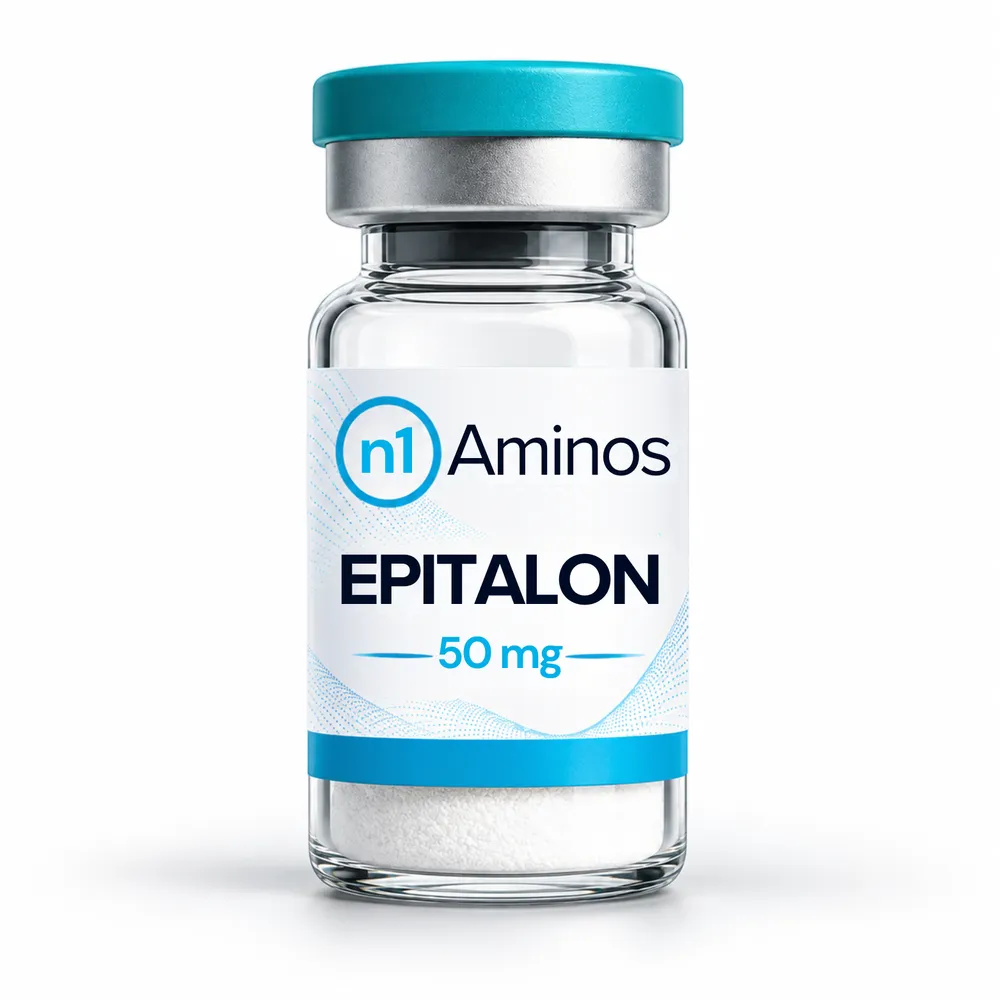
Epitalon 50mg
Third-party tested, lot traceable, ships in 3–5 business days.
Overview
Epithalon, also called Epitalon, is a tiny peptide that activates your body’s built-in anti-aging system by lengthening telomeres—the protective caps on your chromosomes that shorten with age, causing cells to age and die prematurely. Discovered from the pineal gland, it boosts telomerase enzyme activity, essentially turning back the cellular clock to keep cells youthful and functional longer. Human studies show it reduces mortality by 1.6 to 4.1 times in older adults, improves eye health in retinal diseases, and protects against chromosome damage from aging or illness.
Common benefits include stronger immunity, better sleep regulation, improved skin elasticity, and enhanced cognitive function as it combats oxidative stress and inflammation. People report increased energy, sharper memory, and slower visible aging signs like wrinkles or gray hair. It’s particularly promising for longevity, with research linking it to longer lifespan in animals and humans through pineal gland support. Administered via injection in short cycles, Epithalon offers a natural way to maintain vitality as years pass. For those over 40 seeking to preserve healthspan, protect organs, and age gracefully, this peptide provides evidence-based cellular rejuvenation.
Studied benefits
- Acts as a telomerase activator, studied for its anti-aging potential and ability to lengthen telomeres
- It regulates melatonin production, improves sleep-wake cycles, and may boost immune function
Reported side effects
- Exceptionally high safety profile in long-term Russian clinical trials
- Side effects are typically limited to minor, transient irritation at the injection site
Protocol
Dosing Schedule (Subcutaneous)
Educational reference only. Not medical advice. Research compounds are not approved for human use. Full disclaimer.
Epithalon (10mg)
Reconstitute with 2.0 mL bacteriostatic water (Final concentration: 5 mg/mL).
Support telomere maintenance, melatonin regulation, and geroprotective effects over time.
Epithalon + Thymosin Alpha-1 (10mg/10mg Blend)
Reconstitute with 2.0 mL bacteriostatic water (Conc: 5 mg/mL each).
Combined geroprotective support (Epithalon) and immune modulation (Tα1) for anti-aging research.
| Phase | Daily Dose (mcg) | Draw at 5 mg/mL | Log |
|---|---|---|---|
| Days 1–20 | 1,000 mcg Ep / 1,000 mcg Tα1 | 20 units (0.2 mL) | + Log |
| Maintenance | 500 mcg each (2x weekly) | 10 units (0.1 mL) | + Log |
Frequency
Daily for initial 20 days; then twice weekly for maintenance.
Timing
Evening administration to align with natural rhythms.
Cycle length
20-day "pulse" repeated every 6 months.
Unit calculator
Set your vial and water; the table above updates.
5 mg/mL
10 doses of 1 mg per vial
Assumes a U-100 insulin syringe (100 units = 1 mL). Educational math only; verify every calculation yourself.
Context
Lifestyle considerations
Maintain a nutrient-dense, balanced diet and practice intermittent fasting or caloric restriction, as these strategies are often researched alongside Epithalon for their synergistic effects on longevity pathways. Stay physically active and engage in regular resistance training to support metabolic health and cellular resilience. Ensure 7–9 hours of quality sleep in total darkness to maximize the body's natural melatonin production, which works in parallel with the peptide's action on the pineal gland. Practice stress management to reduce telomere shortening caused by chronic cortisol elevation and oxidative stress.
Evidence
Research summaries
Epitalon Increases Telomere Length in Human Cell Lines
Findings: Slows down cellular aging, protects DNA from damage, and potentially extends the lifespan of cells.
Inside every cell, the tips of your DNA are protected by caps called "telomeres," kind of like the plastic tips on shoelaces. As we get older, these tips wear down, and when they get too short, the cell dies. Epithalon is a tiny peptide that acts like a key to turn on an enzyme called "telomerase," which rebuilds these tips. In a study using human cells, treating them with Epithalon made the telomeres grow longer—increasing their length by about 33%. This is a huge deal because it effectively hit the "rewind" button on the cell's biological clock, allowing them to divide and stay healthy longer than normal. For a student, think of this as giving your body's building blocks an unlimited warranty so they don't wear out as fast.
Read the study ↗Normalizing Effect of Pineal Gland Peptides on Circadian Rhythms
Findings: Fixes sleep cycles, restores natural melatonin production, and improves deep sleep quality.
Your body has an internal clock that tells you when to sleep and wake up, controlled by a gland in your brain and a hormone called melatonin. As people age or get stressed, this clock breaks, leading to bad sleep. Research on monkeys and older humans showed that Epithalon could fix this broken clock. It didn't just act like a sleeping pill; it actually retrained the brain's pineal gland to make its own melatonin again at the right times. This means better, more restful sleep naturally. The study found that it restored the "youthful" rhythm of hormones, which is critical for energy during the day and repair at night. It’s like resetting a glitchy phone to factory settings so the alarm works perfectly again.
Read the study ↗Epitalon Protects Against Post-Ovulatory Aging and Oxidative Stress
Findings: Acts as a powerful antioxidant, protects reproductive cells from aging, and reduces toxic stress in the body.
"Oxidative stress" is like rust for your body—it damages cells and makes them work poorly. In a study looking at reproductive cells (oocytes), which are very sensitive to aging, Epithalon acted as a shield. It reduced the amount of toxic "reactive oxygen species" (the biological rust) and fixed the energy generators (mitochondria) inside the cells. The result was that fewer cells died and more stayed healthy and functional. This shows that Epithalon isn't just for sleep; it protects the microscopic machinery of life from breaking down under stress.
Read the study ↗More references (6)
- Epitalon protects against aging-related damage of mouse oocytes, 2022
- Epitalon increases telomere length in human cell lines (ALT activity), 2021
- Telomerase upregulation by Epitalon in aging cells, 2017
- Epitalon and its geroprotective effect on the pineal gland, 2015
- Epigenetic regulation of telomerase by short peptides, 2011
- Telomere length regulation by Epithalon, 2003
Identification
Chemistry
- cas
- 307297-39-8 (primary); also 64082-79-7 (alternate designation)
- formula
- C₁₄H₂₂N₄O₉ (for free acid form); C₁₆H₂₆N₄O₁₁ for acetate salt form
- molecular weight
- 390.35 g/mol (free acid); 450.4 g/mol (acetate salt)
- sequence
- N-Ala-Glu-Asp-Gly-C (single-letter code: AEDG; where A = alanine, E = glutamic acid, D = aspartic acid, G = glycine)
- source
- Synthetic; rationally designed based on epithalamin, a naturally occurring peptide from bovine pineal gland
- biosynthesis
- Non-ribosomal; chemically synthesized through peptide bond formation
- type
- Linear peptide; amphiphilic structure containing both hydrophobic (alanine) and hydrophilic (acidic residues) amino acids
Keep exploring
Related peptides
5-Amino-1MQ
5-amino-1-methylquinolinium · NNMTi
- Route
- Subcutaneous
- Dose
- 2.5 mg – 5 mg
- Cycle
- 10–20 days (based on a single 50 mg vial)
CJC-1295 (No DAC)
No DAC
- Route
- Subcutaneous
- Dose
- 1 mg – 2 mg
- Cycle
- 8–12 weeks
CJC-1295 (No DAC), Ipamorelin
No DAC · CJC-1295 (No DAC)
- Route
- Subcutaneous
- Dose
- 333 mcg – 2 mg
- Cycle
- 12–16 weeks
DSIP
- Route
- Subcutaneous
- Dose
- 100 mcg – 500 mcg
- Cycle
- 8–12 weeks